Live Factory Environment: Internal Mezzanine Foundation Excavations
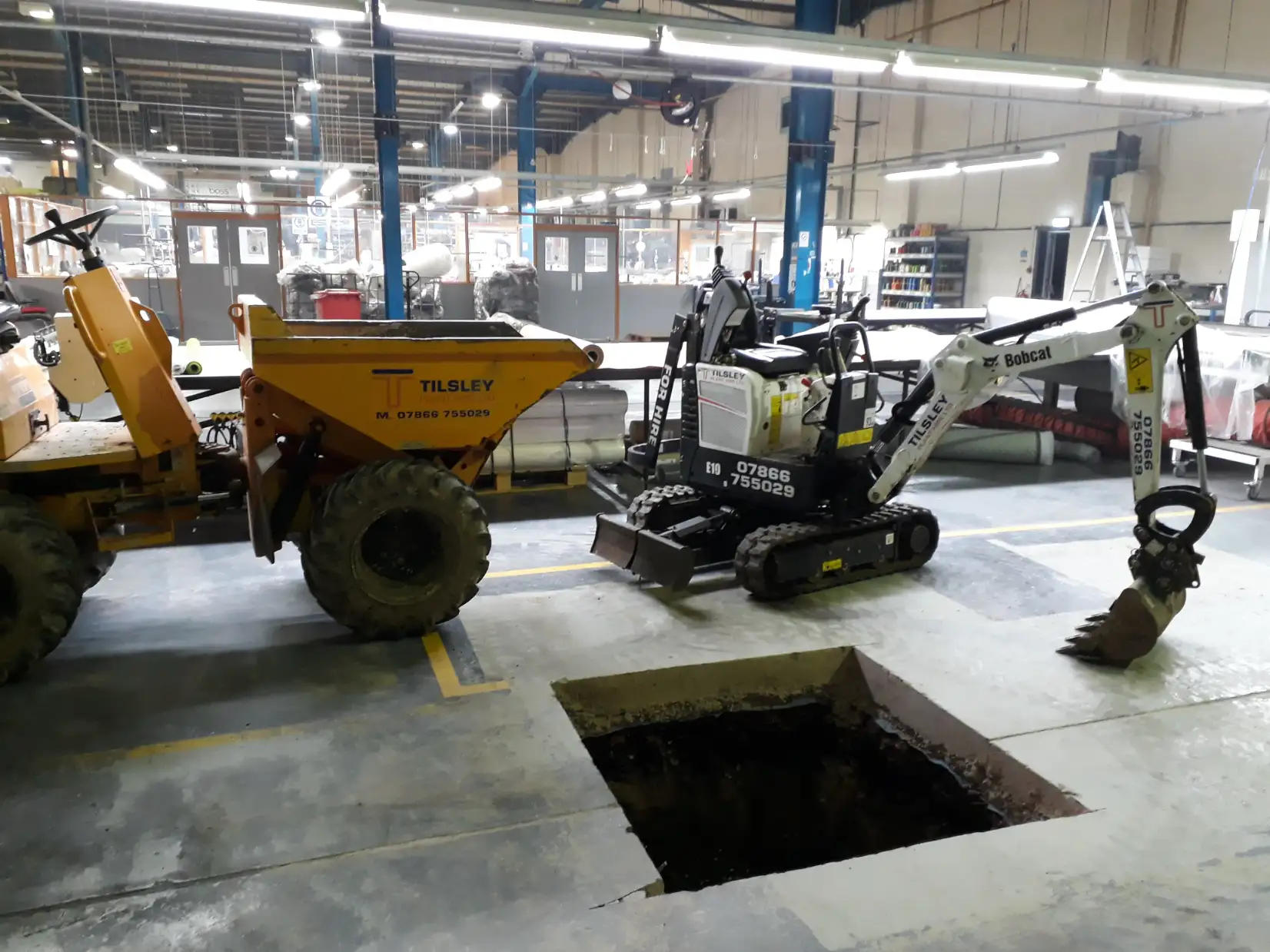

An internal commercial groundworks project carried out entirely during night shifts. Tilsley Groundworks saw-cut and excavated reinforced concrete foundations for a new mezzanine floor within a live factory, managing dust and fumes to ensure zero disruption to daytime production.
Expanding Upwards Without Shutting Down
Executive Summary
For successful manufacturing businesses, space is often the limiting factor for growth. In 2017, our client faced a classic dilemma: they needed more floor space to handle increased orders, but moving to a new facility would cause unacceptable disruption and cost. The answer was to build upwards by installing a structural mezzanine floor. However, retrofitting a mezzanine into a live factory is a logistical minefield. It requires heavy civil engineering—breaking out concrete and digging foundations—right in the middle of a clean production line. The client’s primary concern was not just the structural integrity of the new floor, but the continuity of their business. They needed a groundworks partner who could guarantee that the dust, noise, and vibration of construction would not contaminate their products or stop their machines. Tilsley Groundworks was appointed because we offered a solution that prioritized their production schedule above our own convenience. We designed a night-work programme that allowed the heavy engineering to happen while the factory slept, ensuring the client never lost a minute of revenue.
Precision Night-Shift Engineering
The tilsley Solution
Our solution was total temporal segregation. We established a strict working window between 8pm and 5am. This required a highly disciplined logistical approach. Every night, our team had to mobilise onto the site, set up safety exclusion zones, protect the surrounding machinery, perform the works, and then fully clean and demobilise before the morning shift arrived.
The constraints of working indoors defined our plant selection. Standard outdoor excavators were too large and produced too many emissions for an enclosed factory. We deployed compact, restricted-access machinery from our owned fleet, specifically selected for their low footprint and manoeuvrability. To manage the environmental risks, we implemented a "clean build" protocol. This involved using wet-cutting techniques for the concrete to eliminate airborne silica dust and utilising extraction fans to ensure air quality remained safe for our operatives and the client’s staff the next day.
Diamond Sawing and Restricted Excavation
Technical Implementation
The technical scope of the project involved creating robust load-bearing foundations for the new steel mezzanine columns (stanchions).
Phase 1: Isolation and Protection
Before breaking ground, we shrouded the adjacent factory equipment to protect it from accidental damage or settled dust. We then marked out the grid lines for the stanchions with laser precision. Using floor saws equipped with diamond-tipped blades and water suppression feeds, we cut through the existing reinforced concrete slab. This technique isolated the "break-out" zone, preventing vibration from travelling through the floor and cracking the surrounding slab where the factory machines stood.
Phase 2: Fume-Free Excavation
Once the perimeter was cut, we broke out the concrete within the square. The critical challenge here was fumes. Diesel engines in enclosed spaces are a health hazard. We utilised machinery with efficient filtration and ensured rapid ventilation of the workspace. We excavated the sub-base to the required structural depth for the pad foundations.
Phase 3: Muck Away and Handover
In a tight factory, you cannot stockpile spoil. As the material was excavated, it was immediately loaded into micro-dumpers and carted to skips located outside the building. By 5am each morning, the holes were safely boarded over, the floor was washed down, and the air was cleared, leaving no trace of the heavy engineering that had taken place just hours before.
Seamless Integration of New Infrastructure
The Results
This 2017 project demonstrated the versatility of Tilsley Groundworks. While we are known for large-scale outdoor civil engineering, our ability to execute delicate, high-pressure work within a live internal environment is equally robust.
The client successfully installed their mezzanine floor, drastically increasing their operational capacity. Most importantly, they achieved this expansion without a single day of lost production. By managing the noise, dust, and fumes through our night-shift strategy, we proved that heavy construction and precision manufacturing can co-exist. The project was delivered safely, on time, and left the client with a rock-solid foundation for their future growth.