Coleorton Self-Build: Dual Plot Foundations & Substructure Package

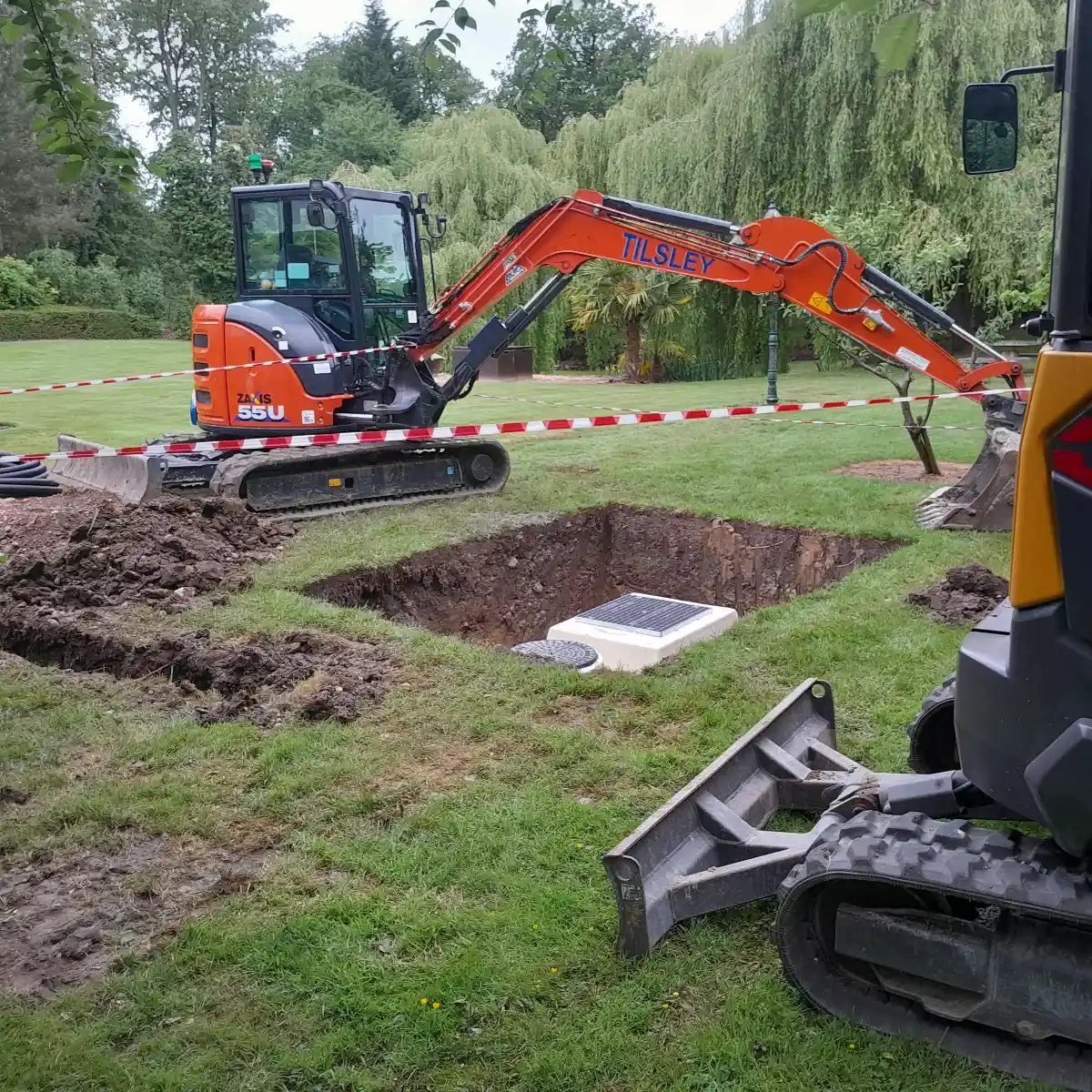
A dual residential self-build project in Coleorton, Leicestershire. Tilsley Groundworks delivered a complete foundation and substructure package, including site clearance, engineering setting-out, brick and block work to DPC, and power-floated garage floors.
Foundations for the Dream Home
Executive Summary
For a self-builder, the groundworks phase is often the most daunting part of the project. It is the stage where the budget is most vulnerable to "unknowns" in the soil and where the structural integrity of the entire building is determined. In 2018, Tilsley Groundworks was appointed by two clients in Coleorton to manage this critical phase for their new luxury homes. Building two bespoke properties side-by-side requires rigorous logistical coordination to ensure neither site delays the other. Our clients needed more than just a digger driver; they needed a technical partner who could read the drawings, manage the levels, and construct the brickwork up to the damp-proof course (DPC). Tilsley Groundworks took ownership of the entire footprint, managing the heavy earthmoving, the technical engineering, and the skilled masonry required to get the houses out of the ground and ready for construction.
A Turnkey Substructure Package
The tilsley Solution
Our approach to self-build projects is to remove the complexity for the client. Instead of the client having to hire a separate setting-out engineer, a bricklayer for the substructure, and a concreting gang for the floors, Tilsley Groundworks provided a holistic solution.
We began with a strategic site clearance. The existing vegetation was stripped back, and the high-quality topsoil was carefully segregated and stockpiled. This is a crucial detail: by preserving the nutrient-rich topsoil on-site rather than carting it away, we saved the clients the future cost of importing soil for their gardens. We then managed the transition from earthworks to engineering, working directly with the Setting Out Engineer to pin the exact foundation lines for both properties, ensuring millimeter-perfect accuracy for the structural walls.
From Excavation to Power Floating
Technical Implementation
The technical scope involved four distinct phases of construction:
Phase 1: Excavation and Concreting
Following the engineer's lines, we excavated the foundation trenches to the required formation depth, inspecting the ground conditions to ensure sufficient bearing capacity. We then coordinated the pour of the mass concrete footings, creating a level base for the masonry.
Phase 2: Brick and Block to DPC
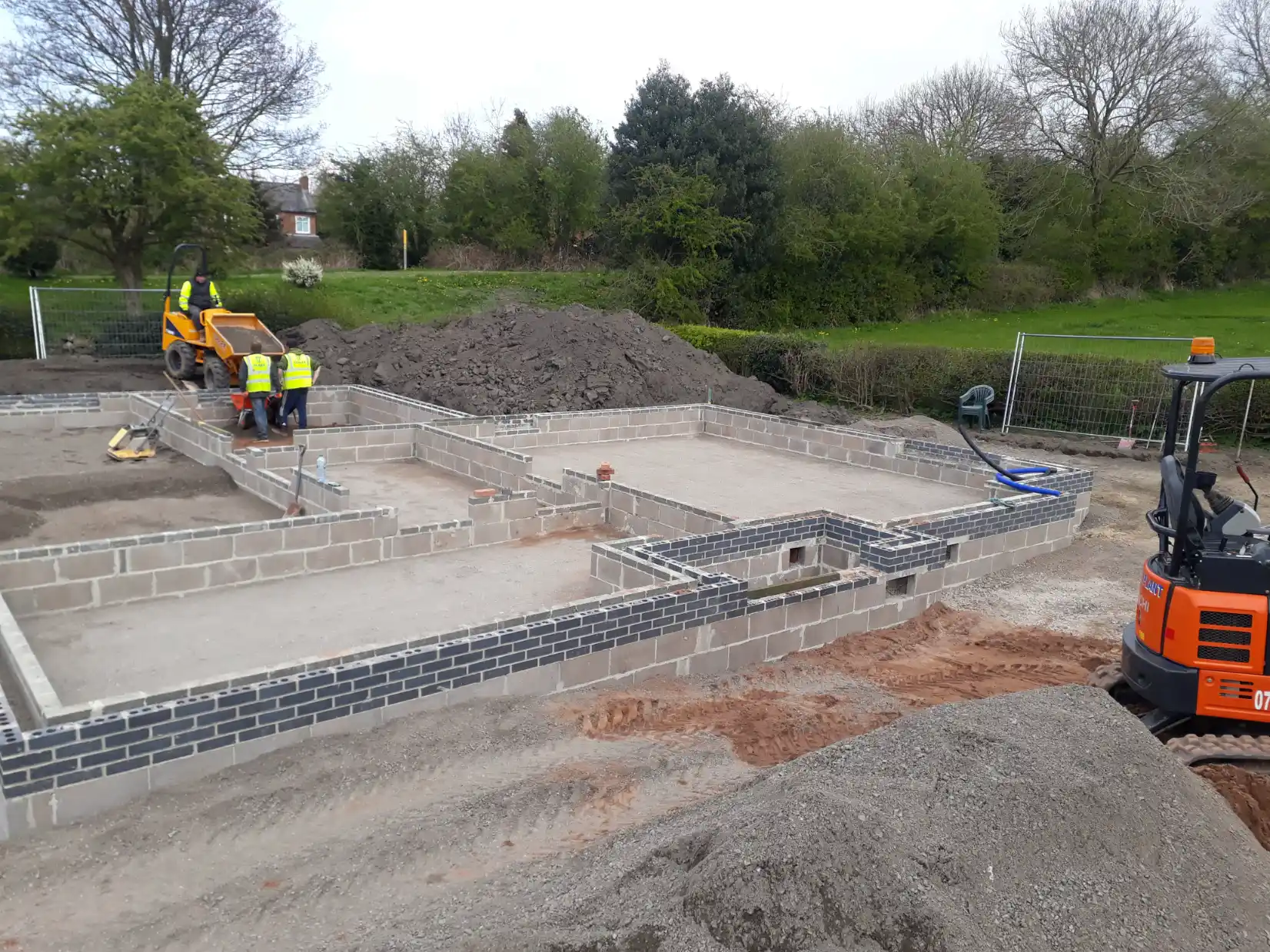
Unlike many groundworkers who stop at the concrete, Tilsley employs skilled bricklayers. We built the substructure walls using engineering bricks and high-density blocks, raising the footprint up to the Damp Proof Course (DPC). During this phase, we installed the internal drainage pipework, sleeving it through the walls to connect the future bathrooms and kitchens to the mains.
Phase 3: Floors and Cavities
With the walls built, we filled the cavity to the specified level with lean-mix concrete to prevent settlement. We then installed the floor insulation and reinforcement before pouring the ground floor slabs.
Phase 4: Power Floated Garages
For the garage areas, a standard tamped finish was insufficient. We utilized a power float—a machine with rotating steel blades—to polish the wet concrete surface. This process closes the pores of the concrete, creating a dense, dust-free, and incredibly hard-wearing surface ideal for vehicle storage and workshops.
Ready for the Superstructure
The Results
The project in Coleorton was a resounding success for both self-builders. By 2018, both plots had successfully emerged from the ground. The foundations were solid, the drainage was live, and the floors were perfectly level.
The power-floated garage floors provided an immediate "wow factor," demonstrating the industrial-grade quality Tilsley brings to residential work. By handling the topsoil management, the engineering, and the masonry in-house, we saved the clients significant time and administrative stress. We handed over two pristine sites, allowing the bricklayers and timber frame teams to arrive and start building immediately on a platform of absolute precision.