Shirley Golf Course: Sustainable Water Harvesting & Pond Extension
A precision civil engineering project for a golf course in Shirley, Birmingham. Tilsley Groundworks doubled the size and depth of an existing irrigation pond to boost water harvesting capacity, utilizing low-impact machinery to ensure zero damage to the luxury turf.
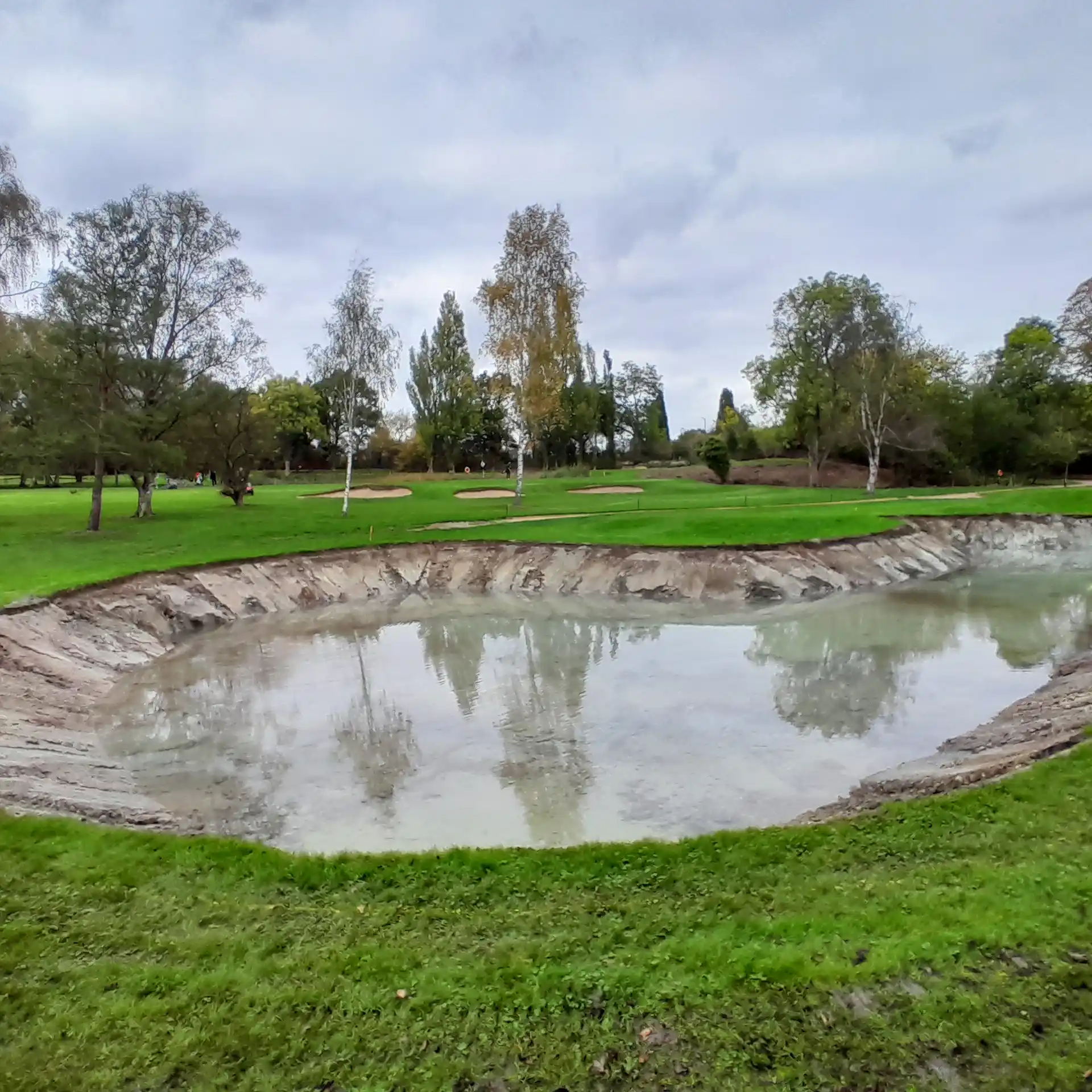

A precision civil engineering project for a golf course in Shirley, Birmingham. Tilsley Groundworks doubled the size and depth of an existing irrigation pond to boost water harvesting capacity, utilizing low-impact machinery to ensure zero damage to the luxury turf.
Securing Sustainable Irrigation for Shirley Golf
Executive Summary
For any golf course superintendent or Greenkeeper, water security is the foundation of their trade. The droughts of recent years have highlighted the need for robust, on-site water harvesting solutions. In 2025, our client in Shirley, Birmingham, took proactive steps to future-proof their course against summer shortages. They required a civil engineering partner who understood that a golf course is not a typical construction site. It is a living, high-value asset where a single oil leak or heavy track mark can cost thousands in repairs and lost revenue. Tilsley Groundworks was selected for this sensitive expansion project because of our reputation for "surgical" excavation. The brief was clear: take an existing, under-sized pond and transform it into a substantial irrigation reservoir, doubling its volume and depth, without the members or the grass noticing the heavy machinery required to do it.
Low-Impact Excavation & Design Shaping
The tilsley Solution
Our solution centred on "Ground Pressure Management." Moving heavy clay spoil requires heavy dumpers, but heavy dumpers destroy fairways. To solve this, Tilsley Groundworks implemented a strict haul-road strategy using ground protection mats and specialist flotation-tyre dumpers.
We worked directly alongside the Head Greenkeeper to interpret their vision. This was not a standard square hole; the design called for organic curves and specific bank gradients that would look natural once filled. Our operators used the latest excavator technology to carve the new banks, carefully stripping and stockpiling the topsoil for re-use before attacking the subsoil to achieve the new, significant depth required for maximum water retention.
Precision Grading and Spoil Management
Technical Implementation
The technical success of this water harvesting project relied on two key factors: depth control and spoil logistics.
Phase 1: Protecting the Asset
Before a single bucket of earth was moved, we established a designated "Green Route" for our plant. By utilising bog mats and restricting travel to specific corridors, we ensured that the 14-tonne excavators and 9-tonne dumpers exerted less ground pressure per square inch than a standard maintenance tractor.
Phase 2: The Extension
We excavated the pond to a new structural depth, effectively doubling the cubic metre capacity of the water body. This involved the removal of significant tonnage of heavy Birmingham clay. Our team utilised 360-degree excavators with grading buckets to shape the "batters" (slopes) to a safe 1:3 gradient, ensuring stability for future maintenance mowing while maximising the water volume.
Phase 3: Integration
The spoil was carted away to a designated sacrificial area of the course or removed from site entirely, depending on the client's material management plan. Finally, the stockpiled topsoil was re-spread over the new banks with laser-guided precision, leaving a perfect seedbed that would knit seamlessly into the existing rough.
A Drought-Proof Asset Delivered Pristine
The Results
Handed over in October 2025, just in time to catch the winter rainfall, the project was a resounding success. The golf course in Shirley now boasts a reservoir with double the previous holding capacity, providing a critical buffer for the irrigation system during the warm summer months.
Most impressively, the work was completed without a single complaint regarding turf damage. Tilsley Groundworks proved that heavy civil engineering can coexist with delicate sporting environments. By listening to the Greenkeeper and respecting the ground, we delivered a functional, sustainable water asset that looks as though it has always been there.